

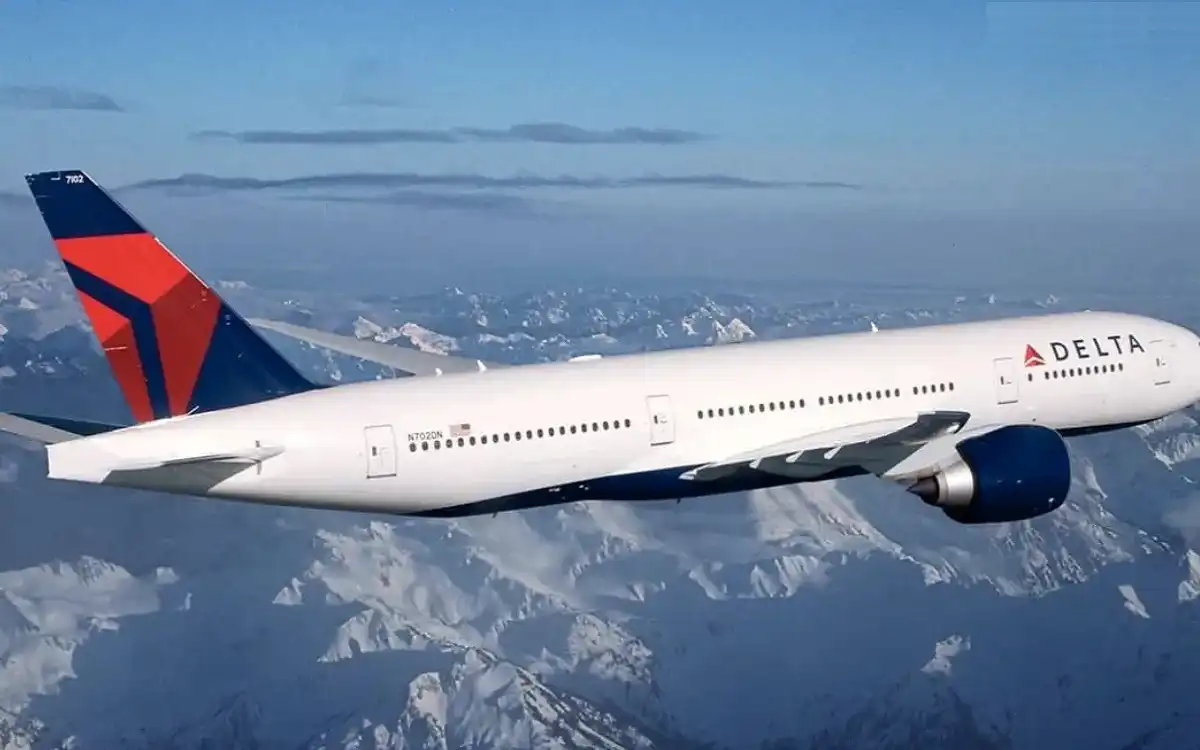
Delta Airlines recently dealt with a major incident when Delta flight DL275 diverted LAX, disrupting operations and attracting attention from travelers around the world. This incident, like others Delta has had, highlights the difficulties associated with long haul flights and the quick decisions that must be made when the flight is already in the air.
Current Incident
Delta flight DL275 diverted LAX departed from Detroit Metropolitan Airport (DTW) en route to Tokyo Haneda Airport (HND), a 13 hour flight across the Pacific. Approximately five hours into the flight, while flying over the Bering Sea, the flight crew made a sharp turn back to the US West Coast. The Airbus A350-900 landed safely at Los Angeles International Airport (LAX) on runway 06R, but the abrupt turn caused confusion among passengers and the ground crew. In a time like this, protocol must be followed. With Delta’s support, the captains must make decisions regarding routing to the closest alternate. Fortunately, there were no injuries due to the calmness and professionalism of the flight crew. The divert incident on DL275 to LAX became an overnight sensation on social media and flight tracking websites.
Why Choose LAX for Diversions?
Of all available options, LAX was chosen for due to the support facilities available. LAX has the ability to accommodate an A350 (or code 3 jets) along with the capability to support maintenance services.
LAX was the closest airport option to provide a diversion with respect to previously flown distances. In addition to being closest, Delta has a hub at LAX which means greater access to parts and technicians.
Overall, the proximity to LAX contributed to the diversion requiring less fuel and presenting less risk which are both characteristics of optimal planning.
What are the potential reasons for the diversion?
Diversions of this nature are most often the result of some sort of malfunction. The engine anti-ice system failure is one possible explanation. The purpose of anti-ice systems is to prevent the accumulation of ice on engine components that could lead to problems during near-subs zero cruising altitudes.
Another potential reasons are medical emergencies, and malfunctioning systems. Delta and the FAA will fully evaluate the incident to determine the exact cause of this incident.
In 2025, there will be an increased regulatory scrutiny regarding the age of an airline’s fleet. However, advanced aircraft such as the A-350 are statistically quite safe.
What Delta did right
Delta’s first priority is passengers’ safety and that is an absolute necessity. Upon landing, Delta’s ground crew met the aircraft to evaluate the passengers’ needs and provide appropriate services.
In addition, Delta provided accommodation, food, and vouchers for the passengers to book alternate flights. The airline also allowed passengers to travel on other flights as the fees associated with such changes were no longer applicable.
Delta also did a good job of sending communications via the app and email to provide updates to passengers and prevent frustration.
Effects on Passengers
Hundreds of passengers encountered delays and missed onward connections to Asia. Families were separated, and business travel was disrupted.
Online, many people narrated experiences of the crew’s concern, from additional snacks to careful explanations. “Textbook handling,” said one passenger.
Most received refunds and miles, but a bit of trust was lost.
Wider Operational Implications
One diversion= one snowball. Delta had to balance crew scheduling, plane swaps, and other reroutes. Delays also impacted DTW and HND.
The detour also added a fuel burn cost to Delta believed to be tens of thousands. The supply chain for parts was also briefly strained.
The slots at busy LAX had to be shuffles, impacting partner airlines.
2025 Aviation Safety Changes
New rules from the FAA on the monitoring of anti-ice tech were issued this year. Digital links now provide real-time info which alert ground teams sooner.
In early 2025, Delta implemented AI-driven predictive maintenance which scans for problems before a flight. Events such as DL275 test these systems.
After the polar route incidents, global standards were revised to require dual backups.
Learning from Previous Diversions
History is often a tool to aid a planner. In 2024, other carriers over the oceans reported similar engine alerts. Quick turns were made to avoid more serious problems.
Thousands of flights generate a large volume of data which is used to refine and improve crew training. These are the scenarios pilots practice on a monthly basis.
Table: Key Diversion Statistics for Delta in 2025
| Month | Diversions | Main Causes | Avg. Delay (hours) | Passengers Affected |
| January | 12 | Technical (60%) | 4.2 | 2,500 |
| May | 18 | Medical/Technical (70%) | 5.1 | 4,200 |
| December | 15 | Anti-ice/Weather (50%) | 6.3 | 3,800 |
| Total YTD | 145 | Overall Technical (55%) | 5.0 | 28,000 |
This table includes data pertaining to flown tracks from the beginning of the time series until the end of 2025.
Estimated Costs to Delta
Diverted flights cost Delta around $50,000-$100,000 for fuel, crew, and hotels. For DL275, add the costs for inspections of A350.
Stock value declined 0.5% the next day of the news and from the coverage. Repeats of these are annoying and should be avoided, but annual operational budgets absorb it.
Most costs are covered by insurance, but the damaged reputation caused by these flights is more expensive to Delta.
Crew and Pilot Training Spotlight
Delta trains pilots to complete over 1,500 hours of flying every year. The simulators are designed to replicate the freezing conditions of the Bering Sea.
Post-event debriefs help sharpen these responses. This crew received praise from the FAA.
Passenger Rights in 2025
Delta is obligated to comply with these new rules, but even more, they are providing the absolute minimum.
EU regulation style compensation is applicable to U.S. carriers, but it’s only applicable for international legs, and only if the delay exceeds four hours.
Tech Fixes on the Horizon
Rolls Royce, the maker of the engines, is pushing the software updates for the Trent XWB in 2026, and Delta is currently testing these updates.
There are currently mid-flight inspections with drones that catch ice early.
Media and Public Reaction
Media covered the event from Delta to aviation blogs. Reddit covered news with different theories.
Delta has received a lot of points for transparency. Safe DL275 was the trending posting.
For More Details Visit Focalvent
